Taking a vape on a plane, the battery decides everything
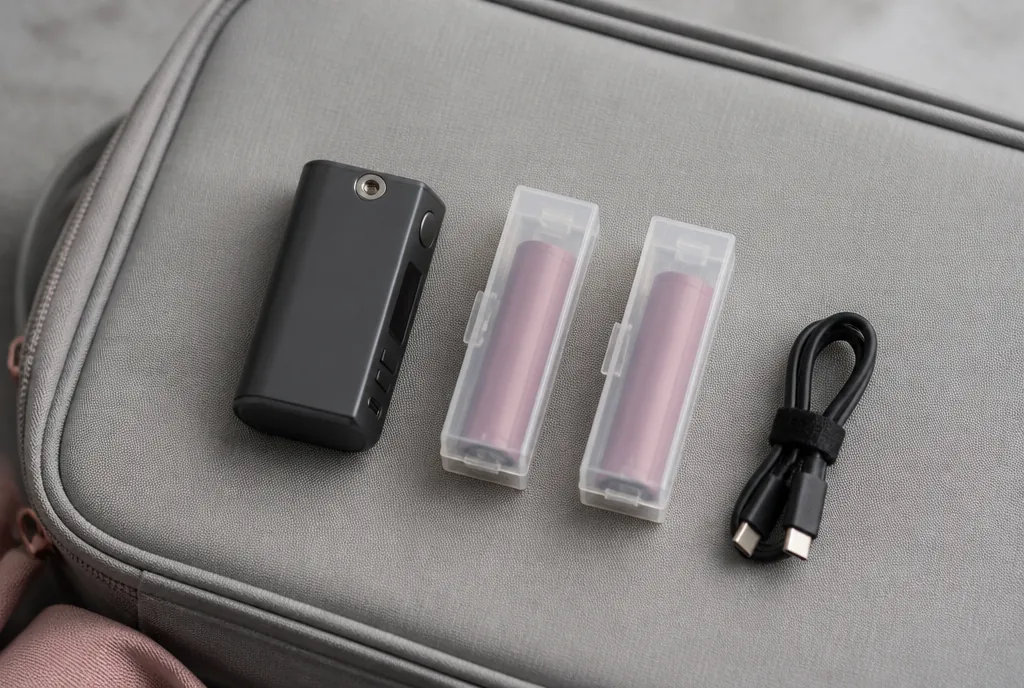
Airport security has no interest in your favourite flavour. What it cares about is the energy you are carrying, whether that is a sealed pod battery, two cells inside a box mod or a handful of spares at the bottom of a bag. Taking a vape on a plane is really a question of managing a small store of lithium energy, with watt-hour limits, packing rules and switch-off requirements attached. Here is how to read them, with the numbers worked through.
Vape on a plane, the rule in one sentence
One sentence covers it. A vape travels in the cabin, ideally on your person, never in the hold, and it is neither used nor charged during the flight.
The UK Civil Aviation Authority sets this out in its table of restricted items, built on the international technical instructions for carrying dangerous goods by air. Battery-powered smoking devices, a category that explicitly includes e-cigarettes and personal vaporisers, are refused in checked baggage, must not be recharged on board, and must be protected against unintentional activation of the heating element.
The logic comes down to the lithium cell. In the cabin, a device that starts to overheat can be dealt with quickly, while in the hold it could go unnoticed. The regulator’s summer 2026 campaign put vapes and power banks at the top of the items it fears travellers overlook, and its figures show reports of overheating or malfunctioning passenger devices nearly doubling between 2024 and 2025.
Airlines can also be stricter than the baseline, and their own rule is often the one that settles things at the gate.
How much energy a vape on a plane really carries
Aviation rules do not think in milliamp hours, the unit printed on cells and spec sheets, but in watt-hours. Converting one into the other takes a single multiplication, and it changes how you look at your kit before a flight.
From milliamp hours to watt-hours
A lithium-ion battery’s energy is its nominal voltage multiplied by its capacity in amp hours. Since 1000 mAh equals 1 Ah, divide the printed capacity by a thousand first. A cell marked 3.6 V and 3000 mAh therefore stores 3.6 x 3 = 10.8 Wh.
Both figures appear on the cell or its datasheet, while a sealed battery’s manual usually gives the capacity and more rarely the voltage. Our guide to choosing a vape battery explains how to read those numbers properly.
The 100 Wh ceiling vaping never gets near
Each lithium-ion battery in or for a smoking device must stay at or below 100 Wh. A 21700 cell marked 3.6 V and 5000 mAh comes to 18 Wh, and a 1000 mAh pod running at 3.7 V sits at around 3.7 Wh.
You would need the energy of more than nine 10.8 Wh cells to reach 100 Wh, and a dual-cell mod changes nothing, because the limit applies battery by battery. The 100 to 160 Wh tier that needs airline approval, and the ban above 160 Wh, concern power tools and large power banks rather than vaping hardware. For a vaper, the issue is almost never energy per cell, but how cells are packed, protected and counted.
Sealed battery or removable cells at security
A pod kit with a built-in battery travels much like a phone. It stays in a pocket or in your hand luggage, switched off, and nothing comes out of it.
A box mod gives you an extra choice. Leaving the cells in keeps it ready for arrival, provided it is fully off and protected against an accidental press. Taking them out cuts the power most cleanly, but every loose cell then has to be packed as a spare, terminals protected.
Our comparison of a built-in or removable battery covers the other differences between the two formats.
Switched off, locked or fully deactivated
Switching off sounds obvious. The rules and some airlines go further, and this is where a device with perfectly acceptable batteries can still be turned away.
What the UK rules ask for
Smoking devices need measures that stop the heating element firing by accident on board, whatever the format. On a box mod, that means powering it fully down and using the button lock if the chipset offers one, following the procedure in the manual for your model.
What some airlines add
Transavia’s French-language help page now accepts only e-cigarettes that can be fully and irreversibly deactivated. It bans devices that fire on inhalation with no button, no lock and no on/off switch, citing a higher risk of fire.
With that airline, a draw-activated pod that cannot be switched off is refused on board, however small its battery. Before you travel, check that your device has a switch or a lock, then read your own airline’s baggage page.
Spare cells, protected one by one and counted
Spare cells travel in the cabin, and each one must be individually protected against short circuits. The UK guidance names the original retail packaging, tape over exposed terminals, or a separate plastic bag or protective pouch for every cell.
A rigid case with a separate slot for each cell follows the same logic of keeping terminals apart. It is the habit already described in our guide to vape battery safety, with one extra demand when flying, separation cell by cell.
Numbers are where the sources diverge. The UK table limits spares to two per person only in the 100 to 160 Wh tier, which no vape cell reaches, and limits power banks to two per person. The passenger page of the European Union Aviation Safety Agency, by contrast, gives a maximum of two spare batteries and power banks per person in total, while the airline mentioned above allows up to twenty loose lithium batteries of 100 Wh or less.
With more than two spare cells in your bag, check your airline’s rule before you leave. The regulator also says batteries showing signs of damage, overheating or swelling should never be carried on an aircraft, which rules out any cell with a torn wrap.
On board, no vaping and no charging
Once seated, two prohibitions apply without exception. Vaping during the flight is not allowed, and neither is charging the device or its cells, whether from a seat USB socket or from a power bank.
The UK table goes as far as saying smoking devices must only be carried on your person, so a pocket beats a bag in the overhead locker. If your cabin bag is taken for the hold at the gate, remove the vape and any loose cells first, as the regulator advises for every lithium-powered device.
Charge before you leave, the only charge you get
Since nothing charges on board, the battery you land with is the battery you took off with. A full charge the night before, with a suitable cable and adapter, saves hunting for a socket on arrival, and our guide on how to charge a vape covers timings and good habits.
A charged device matters at UK security too. The government’s hand luggage guidance warns that a device which does not switch on when requested will not be allowed onto the aircraft, and e-cigarettes appear in the same table, allowed in hand luggage and refused in the hold.
A power bank also travels in the cabin, two per person at most, and for the vape it is there for arrival rather than for the flight.
FAQ
Beyond the batteries themselves, five questions come up again and again before a flight.
Can I take e-liquid in my hand luggage?
Yes, within the liquids rules of the airport you fly from. Most UK airports still cap containers at 100 ml, some accept up to 2 litres, and you may have to show them in a single transparent resealable bag holding no more than a litre. UK nicotine e-liquid comes in 10 ml bottles at up to 20 mg/ml, comfortably inside the 100 ml limit.
Can a power bank charge my vape during the flight?
No. Power banks are allowed in the cabin, but neither the vape nor its cells may be charged on board, and power banks should not be used to recharge devices in flight either.
What should I do if my vape gets hot during the flight?
Alert a member of the cabin crew immediately. A battery that swells, becomes too hot or gives off smoke is a clear warning sign, and crews are trained to handle exactly that situation.
Can I keep my vape in my coat pocket during the flight?
Yes, on your person is exactly where the UK rules want it. Keep it switched off or locked so that keys, coins or the pocket itself cannot press the fire button.
Are the rules different abroad or on the way home?
The battery rules rest on a shared international baseline, but airlines and countries can add their own, and some countries ban vapes altogether. Check the law at your destination and the baggage page of the airline flying you back, which is not always the one that flew you out.
Packing a vape on a plane, energy first
Seen from the energy side, preparing a vape on a plane comes down to a few checks. Working out the watt-hours of your cells settles the capacity question quickly, since vaping sits far below 100 Wh. The real work lies elsewhere, in protecting each cell, keeping their number within your airline’s rule and making sure the device is genuinely off or locked.
Cabin only, no charging on board and a full battery before you leave complete the list. Rules move quickly and vary between airlines, so read their baggage page on the day you fly. Handled that way, taking a vape on a plane is mostly a battery question, the subject Vapelith follows through battery life, charging and device safety.
Editorial content for adult readers only. Vaping products can contain nicotine, a substance that causes addiction, and nicotine vaping products are not for sale to anyone under 18 in the UK. The rules quoted were checked on official pages in October 2026 and can change. This article is not a buying recommendation.